Urea 46%: technical, agricultural and international buyer’s guide
Urea 46% is a nitrogen fertilizer family—not a complete product specification. Buy the form, chemistry, physical quality and shipment together.
20 min read · Technical review · 9 September 2026Download the complete Persian publication
Urea, CO(NH₂)₂, contains about 46% nitrogen by mass and is the most concentrated widely traded solid nitrogen fertilizer.
Granular and prilled urea differ mainly in finishing and physical properties. Fertilizer grade must never be represented as DEF/AUS 32, feed or industrial grade without conformity to the applicable specification.
From natural gas to finished urea
- Hydrogen production from natural gas and purification
- Ammonia synthesis from hydrogen and nitrogen
- Reaction of ammonia with carbon dioxide to form urea
- Concentration of the urea solution
- Prilling or granulation with controlled recycle and cooling
- Screening, coating where used, quality release and dry storage

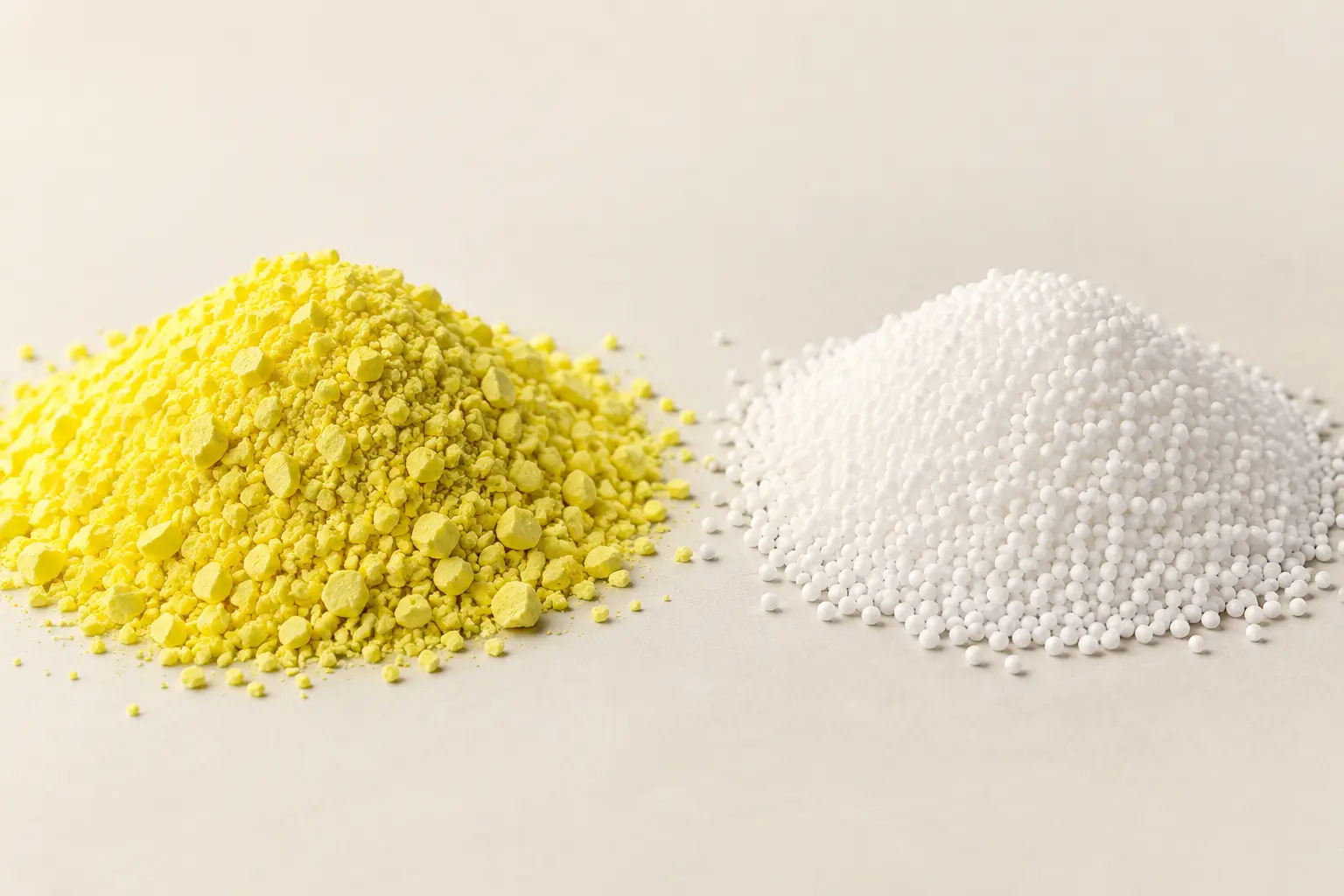
Select the form for the logistics and application
What the COA must define
Total nitrogen
State basis and test method.
Biuret
Critical for sensitive crops and non-fertilizer uses.
Moisture
Affects caking, flow and weight.
Particle-size distribution
More useful than average size alone.
Crushing strength
Predicts breakdown through conveyors and ship handling.
Applications and agronomic context
- Field fertilizer after soil and nutrient-management assessment
- Fertigation or foliar use only with a suitable grade and agronomic instructions
- Urea-formaldehyde and related resins
- AUS 32/DEF only from compliant automotive-grade feedstock and demineralised water
- Ruminant feed only under feed regulations and professional formulation
Packing, inspection and pricing basis
- Bulk shipment with clean dry holds, loading rate, trimming and final-weight method
- Jumbo bags—commonly 500–1,000 kg—with SWL, liner, loops and UV requirement defined
- 50 kg woven polypropylene bags with inner liner where required by the market
- TDS, recent batch COA, SDS, origin, packing, weight and transport documents
- FOB/CFR/CIF plus exact port, form, packing, laycan and quotation validity
Common costly errors
- Calling 46% the product’s purity instead of nitrogen content
- Treating granular and prilled as identical
- Using one producer’s specification for another producer
- Offering nominal plant capacity as available stock
- Selling fertilizer grade as DEF or industrial grade
- Ignoring biuret, PSD, fines, strength and caking
- CFR/CIF quotation without current workable freight and compliance review
FAO values are useful procurement references, not a universal guarantee for every producer or destination. The contract, applicable regulation and batch COA govern.
Technical, market and shipment analysis
Agronomic performance
Urea hydrolyses after application; loss risk depends on soil pH, temperature, moisture, residue, weather and placement. Surface application without incorporation or timely rainfall can increase ammonia volatilisation.
- Choose timing and placement with local agronomic advice.
- Do not translate 46% nitrogen directly into field efficiency.
Caking, dust and physical quality
Moisture, fines, granule strength, storage pressure and temperature cycling act together. A chemically compliant lot can still perform poorly during bagging or discharge if physical quality is weak.
- Request full sieve distribution and fines, not only an average size.
- Define anti-caking treatment, bag liner and storage conditions where relevant.
Global market and Iran
Global urea trade responds to natural-gas economics, plant outages, crop seasons, tenders, export policy and freight. Iran has gas-based production and Gulf access, but plant allocation, sanctions, vessel acceptance, payment route and load-port conditions must be checked for each transaction.
- Separate nominal nameplate capacity from available export allocation.
- Date every market figure and commercial offer.
Inspection and documents
A strong shipment file identifies the producer and lot and includes current COA, TDS/SDS, invoice, packing list, origin evidence, weight and transport documents plus destination requirements.
- Agree representative sampling, retained sample and laboratory.
- Define quantity and quality finality and the claim procedure.
Packaging and ocean care
Bulk cargo needs clean dry holds and protection from rain and condensation. Bagged cargo needs agreed net weight, liner, SWL, stitching, UV resistance, palletisation if any and container moisture controls.
- Confirm loading and discharge rates, free time and responsibility for damaged bags.
- Check destination marking and fertilizer registration before shipment.
Commercial offer and RFQ
State granular or prilled form, nitrogen basis, biuret, moisture, PSD, quantity, packing, origin, load point, destination, Incoterm 2020, shipment window, inspection and payment. CFR and CIF are not interchangeable: CIF adds seller-arranged minimum cargo insurance under the rule.
- Do not call 46% nitrogen ‘46% purity’.
- Fertilizer grade must not be represented as DEF/AUS 32 grade without compliance evidence.
Frequently asked questions
Does urea 46% mean 46% purity?
No. It normally refers to total nitrogen content, usually stated on a dry basis. The full specification includes biuret, moisture and physical properties.
Granular or prilled?
Choose from the buyer’s application, blending needs, size distribution, strength, packing and discharge system.
Can fertilizer urea make DEF?
Do not assume so. AUS 32 requires compliant feedstock and water under its applicable standard.
What should a urea RFQ include?
Form, N basis, biuret, moisture, PSD, strength if relevant, quantity, packing, port, Incoterm, inspection and laycan.
Primary references
FAO — Fertilizer Specifications: UreaISO 22241-1:2019 — AUS 32 quality characteristicsInternational Fertilizer AssociationUSGS — Nitrogen, Mineral Commodity Summaries 2026ICC — Incoterms® 2020 rulesDownload the complete Persian publicationRequest urea with the grade fully defined
Send granular/prilled form, target specification, quantity, packing, destination, delivery window and inspection.
Request a quote